 |
        |
| Home > Articles > What You Should Know Before Hunting With an ATV |
What You Should Know Before Hunting With an ATV
Along With the Great Opportunities Come Some New Responsibilities
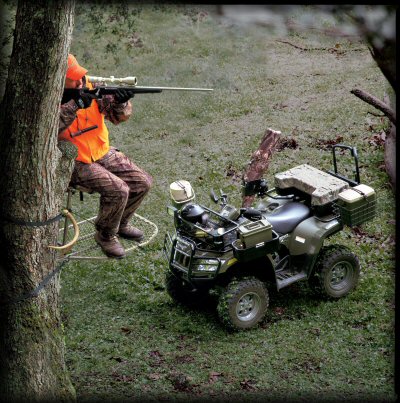
Steve Casper, NOHVCC Director of Communications (January 2020)Over the past couple of decades, ATVs have embedded themselves deeply into the hunting culture. They've become such an important tool that many hunters now wonder how they ever got along without them. Unfortunately, the use of ATVs by hunters has also sparked some controversy, but it is usually the result of a few riders not following some common-sense courtesy rules or fair-chase procedures.
It is of course possible to keep other hunters, trail users, and land owners content with your choice to utilize ATVs in your next big hunt while at the same time maintain a good image in the eyes of the general public. Even experienced hunters may be new to using ATVs and it doesn't hurt to take a moment to review the current ATV hunting etiquette.
To enjoy a better hunt for everyone, follow these simple rules
COURTESY
- Use your common sense to respect other hunters; think about where you are headed and try not to drive across someone elses likely line of sight to reach your spots
- Keep your ATV properly tuned and muffled to reduce exhaust sounds and emissions. Keep your noise to a minimum even if you are a long way from your hunting spot. The sound or smell of your ATV chasing game away from other hunters is the quickest way to create hard feelings.
- Operation of an ATV in areas where motorized vehicles are not allowed is illegal and irritates other hunters who have specifically selected their hunting area to avoid motorized vehicles.
- To increase your chances of success and cause less disturbance to hunters around you, you can access your hunting area before shooting hours and then hunt on foot.
- Retrieve harvested big game during the middle of the day (10 a.m. to 2 p.m.) to reduce conflicts with other hunters. Travel off trail only if travel regulations permit.
- Limit ATV use in and around campgrounds. Be respectful of other campers’ desires for quiet and minimal disruption.
- Slow down or stop your ATV when you approach others on the trail. When meeting equestrians, approach slowly, pull over and stop, turn off your engine, remove your helmet and ask how best to proceed. Keep scouting to a minimum. If necessary, scout for hunting access on legal trails but don’t penetrate hiding cover. It's okay to use an ATV for access but “walk when you stalk”.
- When overtaking others, pass in a safe and courteous manner.
ETHICS
- Increasing numbers of hunters are actually hunting from their ATVs rather than on foot. This behavior raises concerns of "fair chase" and can reflect poorly on hunting and hunters. While hunting from an ATV is legal and appropriate in some states for certain people with disabilities, it is generally accepted that able-bodied hunters should "walk when they stalk" to uphold the "fair chase" ethic.
LAWS
- Be legal and safe. Don't shoot from an ATV. Instead, use ATVs to access hunting areas or, where permitted, pack out your kill.
- Never chase wildlife with your ATV. It's illegal and irresponsible.
- Know the vehicle-use regulations for the area you are hunting. Educate yourself by obtaining agency travel maps to identify and learn legal routes. Contact the local BLM Field Office, Forest Service Ranger District or State Land Management organization for travel management information before you go. Respect road and area closures.
- Stay on existing roads or trails. Cross-country travel on ATVs can create a network of new tracks or trails that cause soil erosion and damage to fish and wildlife habitats. Cross-country travel can also spread invasive species, which can ruin habitat. Do not contribute to resource damage and habitat destruction by creating new tracks for others to follow. When you drive off a road, you leave a track that others will follow and you may be creating resource damage.
ENVIRONMENTAL AWARENESS
- User-created trails are often poorly located
within riparian zones or on steep slopes creating vegetation and soil impacts.
Don't make the problem worse by continuing to use these routes.
- Wheel tracks in wet meadows are like footprints in cement - they often don't heal. Avoid the use of ATVs in wet areas or during wet conditions. Even though the lighter weight and low-pressure tires reduce impacts, ATVs can still do serious damage to wet areas.
- Be prepared to backpack or horse pack game out of areas that do not have existing roads or trails or allow travel off existing roads and trails for game retrieval.
- Don't widen single-track trails by forcing your ATV down the trail.
- Cross streams only at designated trail crossings. Erosion from stream banks and creek crossings can harm survival of native fish.
The National Off-Highway Vehicle Conservation Council (www.nohvcc.org) and Discover Today's ATV (www.atvinfo.org) have taken the lead in the education of hunters who use ATVs and have several new programs that are currently in the works.