 |
        |
| Home > Articles > National Forest Service OHV Travel Management Plan |
National Forest Service OHV Travel Management Plan
Understanding the National Forest Service OHV Travel Management Plan
Jennifer Rails (June 2009)We recently received a package from the Shasta-Trinity National Forest
containing several packets of info about the Motorized Travel Management Plan
that has been in the works since 2005. It took several reads to fully
understand exactly what they were planning and in many ways it was the typical
government verbiage and a fairly complex explanation. While we
respect the enormous task they are trying to undertake, we felt we
could help with the job of explaining what's
happening. This an attempt to sum up what they are planning
to do, specifically on the Shasta-Trinity National Forest, but this should help
you understand the overall national plan as well.
In 2005 the United States Forest Service undertook a huge
project for which all routes that are open to
motorized use needed to be documented. There are
numerous National Forests across the United States and each have individual
districts within, and the deadline to have everything documented and
published was January 2010. The requirement was to include
a finalized map (Motorized Vehicle Use Map, or MVUM) showing all of the trails
and roads where motorized vehicles were allowed – everything else will be
off-limits. 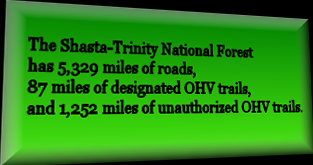
In 2005 the Shasta-Trinity
National Forest completed their inventory of all the roads and trails in
the forest (both designated and unauthorized
routes). They foundd 5,329 miles of roads, 87 miles of
designated OHV trails, and 1,252 miles of unauthorized OHV trails, so the next
step was to figure out which trails would get approved for motorized use in the
future, and hence be shown on the MVUM map.
There is a lengthy
process involved in determining the permitted use for each route, requiring
input from various departments and organizations and from the general
public. In order for any road or trail to be considered for OHV use,
it must be first added to the official National Forest Transportation System
(NFTS). And in order for this to happen, the Draft Environmental Impact Statement (DEIS) must
approve of the trail/route and add it to the NFTS.
The DEIS has two main
purposes. The first purpose is to evaluate previously unauthorized or
newly discovered routes and put them into the NFTS, and the second is to
establish what method of action is going to be taken to add trails to the
forest. So once a route is added to the NFTS, it must then be
evaluated and and approved so it can get added to the Motorized Vehicle Use
Map.
The Forest Supervisor makes the final decision on the permitted use
of the trails, and the official MVUM is then created.
The process:
Stage 1: Identify existing trails
Stage
2: Add trails to NFTS
Stage 3: Public feedback and
debate
Stage 4: Classification of each trail - (with final
bessing given by the forest supervisor)
Stage
5: Creation of the MVUM (Motor Vehicle Use Map)
Shasta-Trinity National Forest
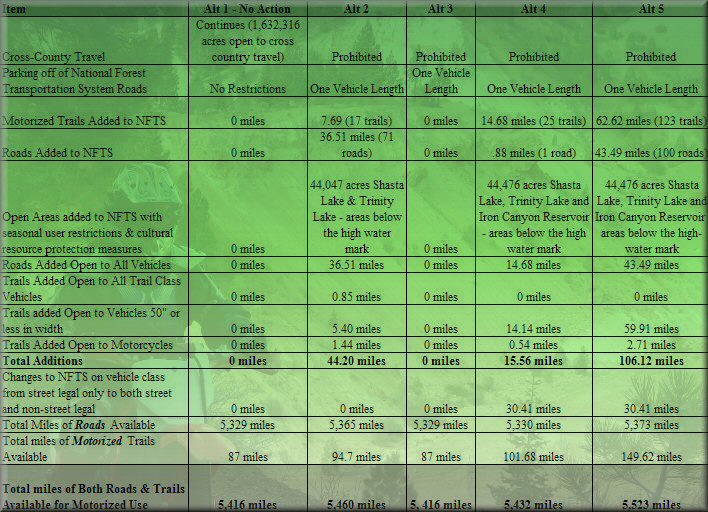
Currently, the Shasta-Trinity NF DEIS is approximately in stage 3 as listed above. They have possible plans of action, with one plan being to take no action at all. This table shows a breakdown of the possible plans.
As a member of the general public, if you want to be involved in the decision making process, now is the time. The first thing to do is to call or e-mail your local ranger district. The Shasta-Trinity NF requires that comments be received within 45 days from the time they publish the DEIS notice which was published in the Federal Register on June 26. This opened the 45-day comment period that is the only time where public comments will make the difference. All comments will be accepted and considered however only those that have verification information can appeal the subsequent decision, so anonymous suggestions carry less weight.
When sending e-mail comments, put in the subject line Travel Management - Comments. Also add the following info:
- Name, address and telephone number
- Title of Project
- Specific comments
- Your signature or verify identity upon request
Shasta-Trinity National Forest
Travel Management
3644 Avtech Parkway
Redding, CA 96002
(530) 226-2421
comments-pacificsouthwest-shasta-trinity@fs.fed.us
http://www.fs.fed.us/r5/shastatrinity/